

FERDINANDO SERASSI – PIETRO PEROLINI, ORGAN, 1877-1878
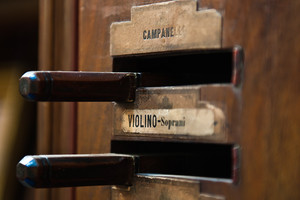
The construction of the instrument dates to the years 1877–1878, the work of Ferdinando Serassi (main organ) and Pietro Perolini (echo organ), who were organ builders from Bergamo. In 1877, the instrument is tested the organist, composer and teacher Carlo Bodro. Fifty years later (1927), the organ builder Francesco Vegezzi-Bossi installed the electric fan as well as a small series of air-controlled tubular bells with a coupler to the pedal mechanism. During the Second World War, a violent aerial bombing in 1943 shattered the glass window overhead and the smithereens made the instrument unusable. Within the scope of the preparatory works of the Diocesan Museum, the gallery and the organ case were restored (Francesco Segreti) and the restoration of the instrument was begun (Brondino Vegezzi-Bossi) and the inauguration was scheduled for 2013. The organ case has three towers, encased by columns and gold-plated pilasters, capitals and a blue-gold, veil-shaped wooden decoration at the top of every tower. The frames of the side towers are straight, whereas a curved frame is over the central tower. The body of the second organ is located behind expression grills to the left of the base of the case. The façade is comprised of 33 pipes, placed on a single row in three pinnacle towers, 11 pipes for each one with a flat profile. The mouths are aligned and the two side towers have mouths placed on an upper level with respect to the central tower, given they are formed by pipes with an elongated base. The console is equipped with two keyboards divided into basses and sopranos.