

Retracing the architectural sequence of events of the Church of Saint Sebastian from its beginnings means immersing oneself in the Middle Ages, when the small Church of Saint John was erected on this site. The fading away of the Confraternity of the same name at the end of the fifteenth century brought about the first renovation of the building, which maintained the old name, yet added the worship of Saint Sebastian.
No trace of the sixteenth-century church has survived yet there is much information which refers to it. We know that not only was the interior frescoed with the stories of the Martyrdom of Saint Sebastian, but that the façade also had a painting with the two saints James and Sebastian on the sides of the Crucifix. The building survived until the second half of the XVI century, when the wartime events necessitated its reconstruction, begun at the end of the same century. The first works concluded with the façade in 1621 and the new church was consecrated four years later. Throughout the entire course of the XVII century, the Confraternity lavished in continuous works to enlarge and embellish the building, from Molineri’s decorations in the 1620s to the enlargement of the oratorio in 1663, enlarging the main body of the church and bringing the façade to its current position. In the subsequent century, massive works were done, including the construction of the sacristy and the Council Room as well as the renovation of the presbytery and the choir stalls (1736-54). In the XIX century, total refurbishment of the nave was required, with the opening of the two lateral chapels, the completion of the neoclassical façade (1889) and the neo-Gothic belfry (1899). The building deteriorated little by little after the Second World War, almost reaching a state of abandon. The radical restauration work that began in 2003 returned the church to its ancient splendor.
The state of disrepair of the Church of Saint Sebastian the end of the sixteenth century was the reason the ceiling of the nave was re-plastered in 1702, however twenty years would pass before proceeding with a new series of work, performed mostly to remold the choir area. In 1729, the Board proposed to intervene for a “better embellishment of this Confraternity, [...] with the use of other works in the church so as to render it decorous”, so with the deliberation on 6 May 1730, authorization is given to begin the work for the “modernization of the choir”. The work prompted the modification of the previous space, completed by master craftsmen Fontana and Scala at the end of the sixteenth century. More work was completed between 1730 and 1731, including closing off the large door which opened behind the altar (today a trace of the frame on the outer façade of the wall remains), to the completion of the two side niches and, at the same time, the construction of the new rooms adjacent to the sacristy and the Council Room. The works for the new altar are delayed until the second half of the 1730s, when in 1736 the consultation of the Monregalese architect Francesco Gallo is requested. Still in 1741 the Confraternity decided to incur the expenses for the “the restoration of the pews to be placed in the abovementioned choir”, in addition to cleaning the ancon, refurbishing the balustrade and “painting the side arches to make them uniform with the front arch and to the choir”. The current choir was made more luminous thanks to opening the windows in the niches, is therefore mostly the fruit of the eighteenth century interventions. The elegant and imposing Roman-style altar (innovative with respect to the back wall of the presbytery) was completed by replacing the wooden floor with multicolored marble, with groups of angels and cherubs in the stucco decorations by the Luganese artist Cipriano Beltramelli, also in the frontal, whose central frame has an arrow, the symbol of Saint Sebastian. The wooden choir stalls covering the back wall, following the curved movement, are separated by the presbytery area by several elements that survived from the old wooden balustrade; the area in front of the altar includes the two arms of the marble balustrade, joined by a wrought-iron gate. The decoration on the walls and on the ceiling, clearly pronounced by the frescoes in the nave completed by Toselli in the first half of the nineteenth century, is characterized by the trompe-l'oeil architecture by Pietro Antonio Pozzi, in which the fresco Glory of Paradise painted by Alessandro Trono in added on the ceiling. The central ancon with the crucifix and the saints James, Sebastian and the two confraternity brothers by Molineri, were completed during the first decades of the XVII century, which dominates the wall at the center of the presbytery, enhanced by a column and a pilaster which frame it, accentuating the monumental nature of the wall; this is an effect which we find in the evangelists painted by the same artist in the side rib vaults.
The Evangelists
The term obviously derives from the “Evangel”, the good news of which these four people and their disciples are direct bearers. In fact, the Evangel is not simply a chronicle on the life of Jesus, but rather the communication of the experience which various people have starting from the encounter with Him, news which is soon put in writing (a few years after the death and resurrection), validated by the contribution of many testimonies and disciples still living. The extremely close connection with the Holy Spirit has made these experiences and testimonies valid to inspire the life of faith of all the believers, of every culture and of all time. Thus the Bible is born, which is not a “dictation” by God (as is the case of the Koran), but rather the concrete experience of God by the different people through the action of the Holy Spirit. The Church has recognized them as the oldest testimonies (Mark, Matthew, Luke and John), and has kept a distance from the later ones, connected to the legendary and miraculous (the so-called apocryphal Gospels). The four Evangelists are recognizable by a symbol connected to each of their own writings (Mark has a lion beside him, Matthew an angel, Luke an ox, John an eagle). Their images are often painted in the four plumes that support the church cupolas (the paradise which is depicted is “sustained” by the evangelical testimony).
Evangelists
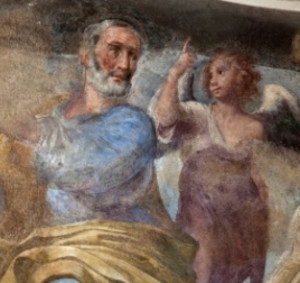
Giovanni Antonio Molineri, Evangelists (1628) | fresco
One year after the completion of the church’s beautiful altarpiece, Molineri was also commissioned in 1626 for a painting with the Holy Spirit to be placed in the molding, several small lateral paintings (now lost) and the frescoes in the plumes of the cupola of the choir with the four Evangelists. Following the transformations which the building underwent, the artist’s hand is only conserved in the plumes closer to the back wall have been preserved (Saint Matthew and Saint John), while the other two (Saint Mark and Saint Luke) were reshaped during the enlargement of the presbytery (1844) by the painter Toselli based on the Molineri models. On the rock at the feet of Saint John, the signature and date read: “I. A. Molinerius, Savil. F. MDCXXVIII”.
Crucifix with saints Sebastian and James and two confraternity brothers
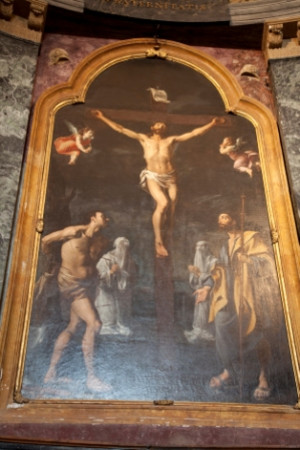
Giovanni Antonio Molineri, Crucifix with saints Sebastian and James and two confraternity brothers, 1625, oil on canvas
The Confraternity of Saint Sebastian begins the refurbishment work on the church choir in the 1620s, based on a project by Captain Giuseppe Fontana. In 1625, Giovanni Antonio Molineri was commissioned to paint the main altar, depicting the Crucifix with Saints Sebastian and James and two confraternity brothers. The two saints are in the foreground, traditionally praying for the epidemics, turning their glances toward Christ on the cross, the center of the composition, but the strong emotional participation also involves the other protagonists in the scene, from the angels soaring around the cross with their hands folded in prayer to the two penitents in fervid adoration. According to tradition, the latter wore typical confraternity garments: to avoid social distinctions between the members and to guarantee that charity is truly free and anonymous (“let not thy left hand know what thy right hand doeth”, the Gospel tells us), they wore hoods to hide the face. In our area, the “white ones” (Holy Cross) cared for the sick, the “black ones” (Mercy) for the prisoners and the dead, the “gray ones” (Saint Sebastian) for the infected persons, the “red ones” (Holy Trinity) for the doctrine. They were also called ‘batù’ (beaten), indicating the practice of public penance (self-flagellation). Molineri is able to give the bodies a strong solidity thanks to his use of light: Saint Sebastian is in a twisted position, delineated by a soft line and by the shape of the shadow, whereas Saint James, clad in heavy drapes, suggests strength and determination. In the dark background, highlighted by the white of the confraternity brothers’ clothes, a realistic view of the city of Cuneo is delineated in the distance with the bridge over the Stura River, and area still called “lower parts of Saint Sebastian” today, on which the Confraternity boasted rights. Considered by the critics as “one of the most mysterious and most profound Caravaggesque paintings”, the work is presented today with the upper “added oval work” painted in 1743 by Pietro Paolo Indio.
Giovanni Antonio Molineri
Giovanni Antoni Molineri was born in Savigliano in 1577. After training at the art studio of his uncle, Giovanni Angelo Dolce, he travels to Rome for specialization, probably from the early 1600s until 1616. Upon returning home, the artist obtains important commissions in the provinces of Cuneo and Turin, also working for the Savoy court. His works are characterized by the union of late Mannerist models with the Roman newness represented by Caravaggio and Carracci, in a personal synthesis and of great fortune, as shown by the high number of pupils evidenced by the sources. Molineri dies in Savigliano in 1631, following a plague epidemic.
Glory of saint Sebastian
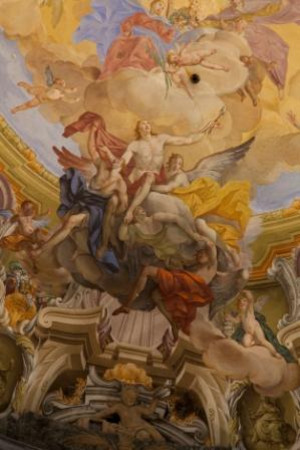
Alessandro Trono, Glory of saint Sebastian, 1743 | fresco
The Confraternity of Saint Sebastian decides to decorate the church choir from about 1736 to 1765. The most intense phase of the work dates to the years 1736-1743, engaging high-level artists such as Pietro Antonio Pozzo, quadraturist called to execute trompe-l'oeil architecture on the ceiling, and Alessandro Trono, well known to the Confraternity since he had been a member and benefactor for some time. The accounting books recorded the times, methods and costs of Trono’s works, who frescoed the ceiling between the spring and autumn of 1743, depicting the glory of the dedicatory saint. The space is enlarged illusionistically through a succession of concentrated rings formed by architectural elements and floral compositions; here the celestial ascent of Saint Sebastian takes place, drawn toward the Empyrean by elegant angelic figures soaring in midair with broad and fluttering drapes. This is the only testimony we have for Trono as a fresco painter, expressing himself in this usual sober and refined style.
Alessandro Trono
Alessandro Trono was born in Cuneo on 3 November 1697. His training is unknown, conceivably conducted in his native city where he works for the Confraternity of the Holy Cross (1724-1732) and the Confraternity of Saint Sebastian (1743). In December 1724, the painter was in Rome during a sojourn for which there is no information; however, there is proof of his participation in the Marsili-Aldovrandi Competition in 1727 at the Clementina Academy in Bologna. Upon his return from his travels outside the region, Trono takes up permanent residency in Turin where he stays until the time of his death on 21 October 1781. With respect to the surrounding artistic environment, Trono continues a personal search, which regardless of the manners of the court painter Beaumont and rooted in the seventeenth-century figurative culture, recovers the linguistic heredity of his land of origin and updates it, above all in light of his experience in Bologna. His works are retraced throughout various parts of Piedmont thus enlarging the catalogue considerably.