

The sacristy was constructed during the restoration work on the building in the first half of the eighteenth century; a large room and well-organized, a service space for liturgical celebrations in the Church of Saint Sebastian, which still keeps its function intact today.
The need for a new sacristy after the destruction of the previous one caused by a fire brought about the construction of the current room around 1730, in conjunction with the Council Room above. The furnishings in the room, recovered in their original positions, meet the functional and liturgical criteria foreseen by the Tridentine decrees in the second half of the sixteenth century. The large engraved walnut wardrobe used to house the furnishing and the sacred vestments still makes a beautiful impression when entering the room. The two large confessionals for “the deaf”, in the corners of the room, represent not only a rare and curious testimony of sacred furniture, but also the concrete memory of the particular attention given to the social problems which the sensitivity of the Confraternity addressed at that time.
The general restoration work on the Church of Saint Sebastian begin at the end of the XVII century, which included the sacristy starting in 1730, the year in which the Council Board of the Confraternity agreed on the construction. At the same time in which these works were being done, in the choir area, construction began of a new part of the building, next to the presbytery and built on two levels. In fact, in 1731 the documents cite “the entrance to the Sacristy”, referring to the lower room, and the future completion of the stone stairway to access the Council Room above. The room, of which the original decoration was recovered, light tones with frames and stucco molding, still present today in its original shape, quadrangular with a ceiling with crossed arches and three large windows. The furniture of the XVIII century includes two large wardrobes with two sections to house the relics, as well as two original confessionals for the deaf, characterized by a large structure with two chairs inside and closed by a door in order to be able to speak freely one’s confession aloud. This is one of the rare remaining testimonies of special confessionals required by the decree of the Council of Trent, showing the attention which the Church demonstrated toward disabled persons. The use of the confessional in religious buildings is widespread in a much later period, and of the precise prescriptions on their structure Saint Charles Borromeo bears witness to in Chapter XXIII of his Instructionum fabricae et suppellectilis ecclesiasticae libri duo in 1577. In addition to guaranteeing the necessary confidentiality during the moment of the reconciliation, the confessional had to be able to be closed by a small gate or by a door so that “when there is no confessor, laity, vagabonds or indecent persons cannot sit or sleep idly, with irreverence to the ministry being exercised.” The sacristy, which still maintains its function today, also houses several of the Confraternity’s precious relics and silver as well as a painting with Saint John the Baptist, Saint Francis and a holy bishop who are holding the Holy Shroud, an indicative testimony of the passage and the devotion the latter had in the Cuneese valleys.
Rayed montrance
RAYED MONTRANCE, PIEDMONTESE SILVERSMITH, (XVIII CENTURY)
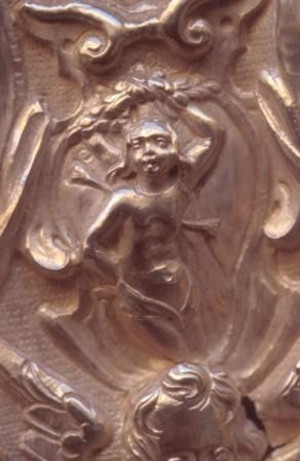
This work is a typical example of a rayed monstrance, which evidently alludes to the identification of the Eucharist with the sun, according to the short Biblical verse in Psalm 18 “in sole posuit tabernaculum suum” (“He has placed his tabernacle in the sun”). The receptacle is comprised of a circular glass case from which rays of various shapes and sizes shoot out; the center and the base have moving profiles with broken lines, richly decorated in highlighted motifs with spirals, festoons of fruit and winged figures on the corners. It was conceived expressly for this church, as testified by the embossed medallions on the base and depicting the main living devotions in this place (Our Lady of Mount Carmel and Saint Sebastian) flanked by Saint John the Baptist. As usual, there are elements of the Eucharistic symbolism on the monstrance: bunches of grapes and sheaves of wheat. The stamps on the base – unfortunately not legible – declare the workmanship in silver.
The Silver
Most of the ecclesiastical furnishings are made of silver. The quality of the metal, the origin of the mint, and sometimes the silversmith are indicated on the stamp, a small brand impressed on the surface of the metal. There are different techniques to work the metal: fusion, embossment, chiseling, and engraving; the noblest parts, like the cups of the used for the wine during the Eucharist, must be gold-plated.