

The Council Room was built at the beginning of the 1730s, in the peak of one of the most profound transformations which affected the entire building. For at least two hundred years the Confraternity of Saint Sebastian made the most important decisions here regarding its activities as well as defining the close bond with the city’s community.
The room was restored to its original state after a long period of abandon in which seepages of rain water had seriously damaged the building. The simplicity of the refined atmosphere reflects the taste of the bourgeois of the nineteenth century: the long table in the center of the room, the large walnut wardrobe behind it to archive the Confraternity’s acts, accounting and registers. The paintings on the walls, which include portraits of several benefactor brothers, enhance the room giving it an almost domestic atmosphere that has remained intact over the centuries. Centuries in which the Scotto-Chiabrand Charity met here, founded thanks to the generosity of two large Confraternity benefactors who by leaving their wealth for clothing and aid for the poor and orphans, actively contributed to the city’s religious and social progress. In December 1901, the last important meeting of the three city confraternities was held here.
In this room, the Confraternity Council met until the second half of the 1970s. The Council of the Confraternity of Saint Sebastian had established in the session on 31 April 1730, the “construction of a new sacristy […] but also the build a room to serve as a Council Room and where the writings can be safely archived.” The work continues starting the following year, which included a substantial refurbishing of the choir area, and will last into the following decade. The Council Room was built above the sacristy and could be accessed by a stone staircase that was completed in 1731. As foreseen, the room was used both for meetings of the Council of the Confraternity as well as an archive, of which the latter function was maintained until a few years ago. The general state of disrepair of the building had caused an evident neglect of the room, caused mainly by the seepage of rainwater starting in the 1970s, which had heavily damaged the ceiling and the furniture. The restoration work carried out beginning in 2001 allowed the recovery of the original aspect that the room had in the 1800s. The room is comprised of a simple terracotta floor and the striped wallpaper with small white and blue flowers recalls the shades of the ceiling, decorated by a false cornice and grey medallions with arrows and quiver as iconographic symbols of Saint Sebastian. The furnishings were conceived based on the typical middle-class taste of the time and add to creating an intimate and almost domestic atmosphere, with the large Victorian-style leather armchairs and the massive walnut wardrobe placed along the entrance wall in which the archive documents were placed. On the back wall next to the large majolica stove, another reference to Saint Sebastian’s arrows is in the small door on the fireplace. Among the other furnishings are the glass bells with flowers, another characteristic element of the nineteenth-century decorative style; the room conserves the original furniture and the crossed arrows are still visible on the fireplace and in the painted decoration, an obvious reference to the martyr Saint Sebastian and the symbol of the same confraternity. This room also houses the portraits of the confraternity benefactors, the same room that hosted the meetings of the Scotto-Chiabrant Charity for centuries, which foresaw, among other things, clothing twelve poor people on occasion of the city procession of Saint Michael and constituting “two due annual endowments of 120 liras each to be paid to two poor spinsters”. On 23 December 1901, the last important meeting of the three great city confraternities took place: Saint Sebastian, Holy Cross and the Church of Mercy had just come out of a century of serious major challenges and suppressions. The Church of Mercy died out in 1925, whereas the Confraternities of Saint Sebastian and Holy Cross still exist today.
The Scotto-Chiabrant Charity
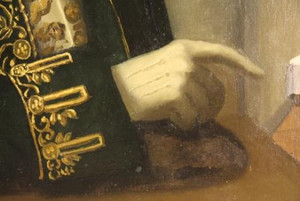
The testament drafted by Mr. Chiabrant in 1727 and the one by Mr. Scotto dated to 1656 provided substantial patrimonies in favor of the Confraternity of Saint Sebastian, with specific charitable purposes. Thanks to these benefactors, every year for almost three centuries, six young women were selected randomly to be married, whose names were noted by the parishes in the area, to whom a dowry dote was to be assigned (thus guaranteeing them a good chance of finding a husband) and by the same method 12 poor people were clothed. The extractions, accurately written in the meeting minutes which we have in our possession, were taken in the Council Room, then made public on the altar of the Church our Lady of Mount Carmel. The large hall still houses the portraits of the two benefactors. All the beneficiaries were expected pray in suffrage of the bequeathals and participation in the procession in honor of Saint Michael. The work, as with hundreds of other similar works, was abolished by the Napoleonic storm and then by the Savoy laws whereas its patrimony was forfeited in favor of public assistance.