

Pope Pius VII arrived in Cuneo on 12 August 1809, prisoner of Napoleon’s soldiers. On 17 July 1817, the same pontiff proclaims the birth of the Diocese, an event that had been long awaited for many centuries.
The first attempt to make Cuneo the seat of the diocese dates back to the XV century. Beginning in 1803, it was the capital of the Department of the Stura and seat of the Bishopric, Chapter House and Seminary of Mondovì. Pius VII’s sojourn in 1809, the only pope ever to pass through the city, was decisive within the scope of this event. With the fall of Napoleon, the pontiff – grateful for the welcome he received and thanks to the intercession of the Cuneese nobility – issues the bull Beati Petri Apostolorum Principis (1817), thus instituting the new diocese. The choice of the bishop, which is the competency of the king, is Amedeo Bruno di Samone. On 23 December 1826, the Municipal Council approves the bishop’s proposal to elect Saint Michael the Archangel as patron saint of the city and of the diocese. With the same bull, blessed Angelo Carletti is elected protector and defender of the city.
During the night between 5 and 6 July 1809, about three o’clock in the morning, General Miollis forces entry in the Presidential Palace and arrests Pious VII, following the Pope’s ostentatious refusal to annul the bull of excommunication against Napoleon and renounce temporary power. The pontiff is escorted feverishly by carriage along with the Secretary of State, Cardinal Pacca, first to Florence then to Genoa, later taken to Alessandria and Rivoli. The Pope is then taken to Grenoble, via Mont Cenis, where he is separated from Cardinal Pacca and forced to re-enter Italy via Valence and Nice. After having gone up the Roja Valley again, on Saturday 12 August 1809 the convoy departs again, arriving in Borgo San Dalmazzo at about 5:30 PM then in Cuneo in the evening at the Gate of nice (current Galimberti Square) where the mayor of Cuneo, Count Filippo Lovera di Maria, awaits him, offering hospitality to the pontiff in his family palace, situated along the Contrada Maestra. At about 8 PM, the Pope gave the blessing to the crowd that had gathered under his balcony, followed briefly by fireworks that had been prepared the next day on occasion of the feast day of blessed Angelo Carletti of Chivasso, but were displayed that evening in honor of the Pope. About 9 PM, he has a light fish dinner served by the city’s best restaurant. On Sunday August 13, the Pope takes part in the mass celebrated by Monsignor Doria Pamphilj in the large palace hall, thus receiving and blessing the people for the third time, yet more and more people hastening from the nearby towns. After a very brief stop to visit the elderly and ill Count Bruno of Tournafort, the convoy departs toward Mondovì, passing through Rocca de’ Baldi where the pontiff lunches with the notary Carlo Prandi. Pious VII stays in Mondovì for three days, the guest of the mayor Fauzone di Germagnano. On August 16, via the Cadibona Pass in a sedan chair, Pious VII reaches Savona, where he remains prisoner for nearly five years.
Episodes of the life of Pious VII
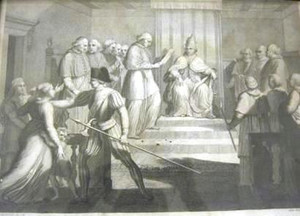
LIGURIAN AND TUSCAN ARTISTS, EPISODES OF THE LIFE OF PIOUS VII (FIRST QUARTER OF XIX CENTURY) | from CUNEO, CATHEDRAL OF SAINT MARY OF THE WOODS
Despite the Napoleonic prohibition of the circulation of images and writings regarding the Pope, during the rare and fleeting encounters, several Savonese artists painted “clandestine” portraits of Pious VII, initiating a widespread iconography. Effigies of the Pope reproduced on every sort of support circulate as well as engravings and postcards with episodes of his life. Most of the prints, from which those exhibited derive, are widespread throughout the entire peninsula. The engravings, also spread widely throughout the peninsula, are mainly by Tuscan artists. Evidently commissioned to satisfy the demand of the devotees of Pious VII and emphasize the extraordinariness of his image; the events narrated regard many episodes full of pathos and exceptional occurrences of his sequence of events (such as the Pontiff’s ecstasy during the prayer or the apparition of an angel). It is a sort of a Via Crucis (Way of the Cross) in which the suffering image of the Holy Father is the protagonist. The veneration of the people toward him and Pious VII’s most remarkable qualities are always underlined in the scenes, such as his determination, the rigor in which he acts and the dignity and pardon which distinguishes him during his long and difficult imprisonment. All the images provide the names of the artist and the engraver as well as a brief and poetic description of the episode represented.
Engraving
Engraving is a technique that can be produced as either intaglio or relief. Intaglio is when a metal matrix is engraved directly with particular instruments such as graver, niello, drypoint, or through acids (etching, aquatint); the ink penetrates the grooves, which are molded through the action of the instruments or the acid. The impression on the paper leaves the sign of the matrix. Relief engraving, or relief etching, is when the matrix is etched in high relief; when the support is made of wood, it is called xylography.
Chalice
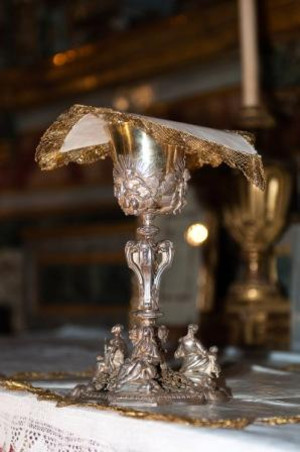
IGNAZIO RAVIZZA, CHALICE (SECOND HALF XVIII CENTURY) | EMBOSSED, CHISELED, GOLD-PLATED SILVER
The chalice arrived at the Cathedral of Cuneo via an unusual path that can be partly reconstructed thanks to the inscription on the base: “CANONICUS COELESTINUS DE ASTE AD USUM SUMMI PONTIFICIS PII PAPAE SEPTIMI TAURINI DIE 25 ET 26 APRILIS 1805 DEDIT”. In April of 1805, Pious VII passed through Turin on his return journey from Paris where – on December 2 of the previous year – he had attended the coronation of Emperor Napoleon. On that occasion, the canon Celestino De Aste gifted him the precious chalice made by the Turinese silversmith Ignazio Ravizza in the last quarter of the XVIII century. When the imprisoned pontiff passed through Cuneo in 1809, he gifted the chalice to the canons of the Collegiate Church of Holy Mary of the Woods who (as the chronicles recount) “... wished to have the honor to supply what was needed for the Papal Mass, but impeded in everything, offered the Holy Father a chalice who wished it to be the chalice of comfort and exultation. The expressed a centuries-old wish to the Pontiff, that Cuneo might have a bishop like the other cities, even smaller cities in Piedmont. Pious VII received the chalice with much affection and since he could not have two with him during his journey, he gifted His chalice in exchange; he had even used it that morning. It is now safeguarded with care by the canons; that chalice, memory of the great Pontiff, it served for the pontificals of all our Bishoprics and is therefore a precious keepsake for the Diocese….” (from RAM – Repertorio di Antiche Memorie – Tome II – The Processional Banner, 19 September 1919).
Saint Michael
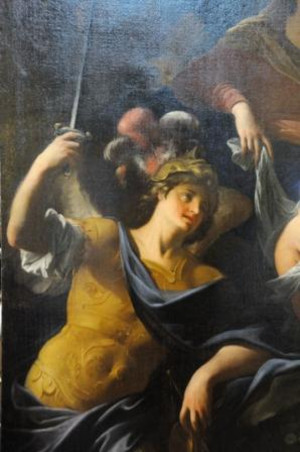
Who is like God? This can be the tradition of the name Michael. Protagonist of the book of the Apocalypse, he is the Archangel whom God entrusts to combat the Devil. In the Hebrew Christian vision, in fact, evil is personified and does not have the same weight as God, there is no contrast between good and evil as two equal and contrary forces. God is the one, highest and total Good. In creation, freedom is also open to evil, the refusal of good. Yet the Devil (= he who divides) is subjugated by to God, an angel who did not trust God and whom Saint Michael combats, indicating God as the sole reference and sole Lord. When the new Bishop arrived in Cuneo in 1817, the memory of other local saints (starting with Saint Dalmatius) seemed too weak to identify a patron saint. Rereading the oldest chronicles of the foundation of the city, it is underlined that the first act was written in the chapel of the Church of Our Lady of the Woods, at the altar of Saint Michael and therefore the decision was made to entrust the Archangel with the protection of the new diocese.
The Birth of the Diocese
The first attempt at making Cuneo the seat of the diocese dates back to the XV century. For a long period, the Cuneese territory is subject to the jurisdiction of other diocese: Asti, Mondovì, Fossano and Turin. In 1559, when Cuneo obtains the title of city from Emmanuel Philibert, the hopes are rekindled, but are short lived. In 1783, the official procedures begin at the Royal Court. On 1 June 1803, Napoleon imposes the suppression of numerous dioceses and the transfer of the Bishopric to Cuneo, the Capitol and the Seminary of Mondovì, from the moment it is the capital of the Department of the Stura. Pious VII’s sojourn in Cuneo on 12-13 August 1809 is decisive within the scope of the entire affair. The decisive phase begins after the fall of Napoleon and the subsequent Restoration. Through the deliberation on 25 November 1814, the Municipality delegates two patricians: Count Pascal d’Illonza and the Marquis of Clavesana to negotiate the construction of the Diocese. In Rome, the procedures are handled by an illustrious Cuneese man, Count Clemente Solaro della Margarita. Through the deliberation on 1 May 1815, as part of the endowment the Municipality offers one of his farmhouses on the other side of the Stura River an income of four thousand liras and agrees to pay thirty thousand liras to purchase a respectable bishop’s palace. On 17 June 1816, during a visit to Cuneo, King Victor Emanuel II is housed in the palace of the mayor, Count Angelo Ricci of Andonno. On this occasion, new motions are presented for the Bishopric. At last, in 1817, the endowment is completed by the Cathedral Priory, theologian Giovanni Battista Giraudi, and Tornaforte Palace is purchased, previously the seat of the Prefecture under the French government, which is still the seat of the Diocesan Curia today. With the bull Beati Petri Apostolorum Principis on July 17 (which is followed by another bull on 29 October 1817), Pious VII redefines the Alpine Dioceses and institutes the new diocese of Cuneo, obtaining the territory from the Diocese of Mondovì. At the time of its institution, the new diocese has about fifty parishes; today there are 82. The choice of the new bishop, the competency of the king, is Amedeo Bruno di Samone. On 23 December 182, the Municipal Council of Cuneo approves the new bishop’s proposal, electing Saint Michael the Archangel as Patron Saint of the city Cuneo and of its diocese. With the same bull, the blessed Angelo Carletti is elected special protector and defender of the city.
Portrait of Monsignor Amedeo Bruno di Samone
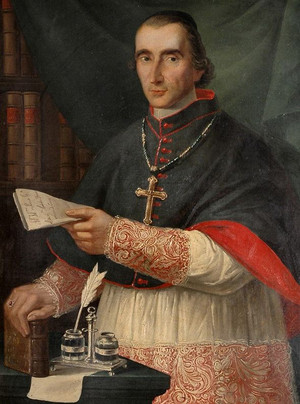
CUNEESE PAINTER, PORTRAIT OF MONSIGNOR AMEDEO BRUNO DI SAMONE, SECOND QUARTER XIX CENTURY | OIL ON CANVAS
Born in Cuneo on 6 January 1754 in the historical Samone Palace in via Amedeo Rossi to Count Francesco Bernardino and Cristina Ricci d’Andonno, he was baptized in the Parish Church of Saint Mary by his paternal uncle, canon Giovanni Giacomo Bruno. He received his degree in theology in Turin, where he was then ordained as a priest on 19 December 1785. He then becomes canonic cantor of the Metropolitan Church after which he was nominated dean of the Faculty of Theology after which he is nominated as the first bishop of Cuneo on 1 October 1817, ordained on October 5 in the Church of the Holy Apostles in Rome by Cardinal Morozzo. At 2 PM on the afternoon of December 28, he arrived in Cuneo to take possession of the diocese, announcing the first diocesan synod and erecting six new parishes, among which Our Lady of the Elms. He dies on 21 December 1838.
The Bishops
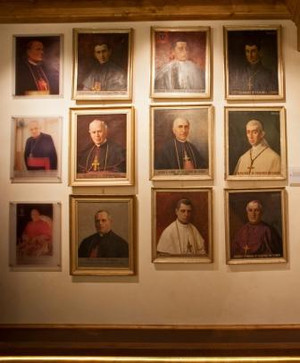
The Greek word ‘episkopos’, from which we obtain the word ‘bishop’, literally means “he who looks down from above”, which is to say a person who has an overview, a wisdom which goes beyond particularity and subjectivity. The image of the Good Shepherd is the one which is most commonly associated to those who are responsible for Christian communities, which are not simply “commanders”, but rather a service of faith for the believers. In the Gospel, in fact, Jesus “calls” many people to follow him and several of his closets collaborators (the apostles or “the dispatched”) to whom he entrusts the preaching and signs of endurance throughout history (the Word and the Sacraments). These, in turn, support other persons who hand down the same services connected to community, which little by little are structured and organized (the dioceses). The mandate is granted from the beginning by an apostle to his “successor” (bishop) through the Chrism unction and the gift of the Spirit, and so forth (thus the talk of an out-and-out uninterrupted chain of apostolic successions). A bishop is thus the greatest expression of service and can therefore organize the local church and ably order the persons in charge of the various territorial communities (the parishes) in three main levels: deacons, priests and bishops. Whenever this does not occur in communion with the other bishops (and for the Catholics with the Pope) a schism occurs (a “breach”, even without being able to judge the validity of the acts a bishop had already rightly ordained). The Pope is the bishop of Rome and the successor to Saint Peter. Catholics recognize him as the font of unity for all the churches, whereas the other Christian denominations (Orthodox, Anglican) have other ways of maintaining the connection among them in an inter pares dialogue (synods, etc.), even though maintaining the same territorial subdivision. A bishop of a very old or very prestigious seat can add the title of archbishop or be part of the “collegiate” of cardinals (the group which elects the Pope), but basically every bishop maintains his role of apostle, whether he performs his role in a large metropolis or in a small provincial diocese. In 1817, with the creation of the diocese of Cuneo, such territory was given a specific bishop. Until now our area had been subdivided into different diocese: Asti, Turin, Fossano and Mondovì. Monsignor Giuseppe Cavallotto is the fourteenth bishop of Cuneo.