

Madonna with Child and Saints
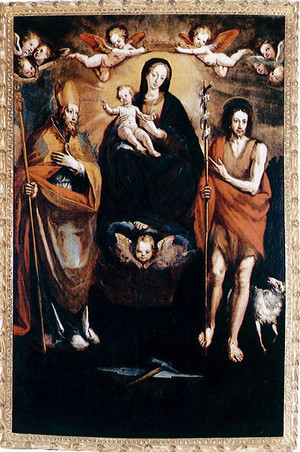
GIULIO AND GIOVAN BATTISTA BRUNO, MADONNA WITH CHILD AND SAINTS ELIGIUS AND JOHN THE BAPTIST, FIRST HALF XVII CENTURY, OIL ON CANVAS
The figures of the Virgin with Jesus and the saints are in the foreground surrounded by winged cherubs, whereas in the center below, an anvil and a hammer, tools for metalworkers, of which Saint Eligius is the patron saint. From here, the hypothesis that can be reached from the “icon of Saint Eligius” recorded in an inventory on 2 June 1852 on the altar of the Society of Menagerists in the Church of Saint Francis in Cuneo. The painting became part of the patrimony of the Confraternity rather late: the stylistic analogies with the wall paintings of Saint Sebastian and with the paintings of the Madonna with Child in the Parish Church in Andonno and the Church of the Holy Spirit in Levaldigi, place the work in the within the scope of the activities of the brothers Giulio and Giovan Battista Bruno, active in the Church of Saint Sebastian and the Church of the Holy Cross in Cuneo in the third decade of the XVII century. The rapid and fluid brush strokes contribute in giving the psychological characterization of the people, who appear meager and gaunt, certainly able to harmonize with the communities of devotees, which at the time had to face frequent famines and pestilences.
Patron Saints
The particular “patron” or “protector” is a common image for many cultures and religions. Christianity developed the cult of the saints as intermediaries between the believers and God (with excesses of zealotry which brought about the refusal of all this by reformation initiated by Luther) in the conviction that certain experiences would be better understood by those who found themselves in the same situations. In addition, the tradition in the east was to write the name of the saint depicted on the icon, in the west the saint is recognized thanks to the symbol that is attributed to the saint, connected to the saint’s life and often to the intercession. So people who have a toothache invoke Saint Apollonia (depicted with pincers with which her teeth were pulled out in fury of her martyrdom), tailors pray to Saint Homobonus, who was a tailor and is depicted with a pair of scissors, farmers look to Saint Isidore. In the Middle Ages, the workers began to organize themselves in corporations and each one elected a patron saint connected to his own profession. Blacksmiths and goldsmiths chose Saint Eligius, a French goldsmith from the VI-VII century who was elected bishop. His sign of recognition is the anvil. The corporations were developed until the start of the XX century.
Immaculate Conception and Saints
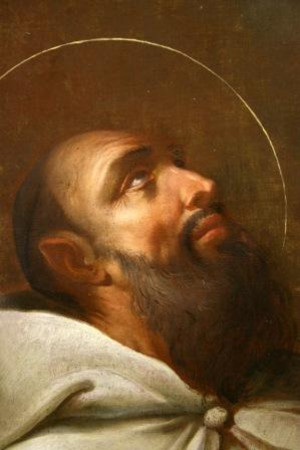
SEBASTIANO TARICCO, IMMACULATE CONCEPTION AND SAINTS, CA. 1680| OIL ON CANVAS
The main figures are in the foreground in a triangular position. The Immaculate Conception stands out in the center of the scene surrounded by a bright cloud of winged cherubs, while on the lower part on the sides the two saints interpreted by the critics as George and Bernard, who identification is still not quite clear. On the left is the holy monk in white garments with a long beard more likely represents Saint Bernard rather than Saint Romuald, a Benedictine monk from the XI century who wished to reform the order by giving life to the Camaldoli. The saint in military attire with the Crusades banner has always been identified as Saint George, although it may well involve one of the Theban martyrs whose cult is widespread in the Cuneese area. In the absence of documentation, the painting is attributed to Taricco for stylistic reasons and chronologically placed in the artist’s more mature phase, around the 1680s, when his young excesses had been long since quieted, the brush strokes and the facial features are more composed. Hypothetically, the painting was identified with the altarpiece that came from the patronage altar of the Bruno di Samone and Berutti families in the Church of Saint Francis, mentioned in the inventory of 1802; the work as apparently brought to the Church of Saint Sebastian following the suppression of the French period.
Sebastiano Taricco
Sebastiano Taricco’s career unravels between the Province of Cuneo and Turin in a path that was not always defined and regular. The painter was born in Cherasco around 1645. The stylistic data suggest initial training under the teachings of local painters (Molineri, Moncalvo and Claret) and on the models learned at the Turinese court. After a series of commissions in the Cuneese area, he encounters Andrea Pozzo, active in the Church of Saint Francis Saverio in Mondovì between 1676 and 1678, which profoundly marks the artist’s style in his most mature period. The brilliant chromatic range and the illusionist game of the Pozzo’s quadrature revitalize Taricco’s style. His success in the Province of Cuneo is overwhelming: he is active in Fossano, Bra and Savigliano, but also in more suburban places such as Castelletto Stura and Chiusa Pesio. The painter’s language seems to express him with a sense of greater freedom and inventiveness compared to the works that he produces for the capital of the Savoy Duchy, where he must face a difficult contrast with the different cultural orientations present on the Turinese scene.
History of a Work
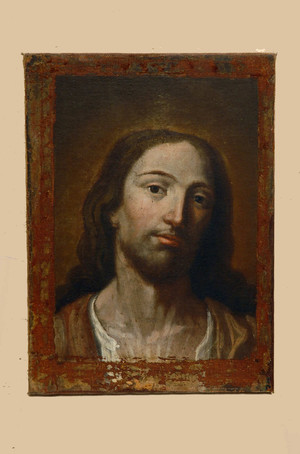
Every work has a history, comprised of reconsiderations by the artist or by the commissioner, change of ownership, or placement site... They are often stories that we ignore yet they are full of fascination, about which novels and historical works could be written. Identifying the passages means reconstructing very different periods and contexts. An example is the history of this painting: it involves a fragment of the image of the “Sacred Heart of Jesus”. The worship of the Sacred Heart is developed beginning in the XVII century, especially in France, where Jansenism was in full swing (spiritual group which preached a very rigorous and intransigent religion, soon condemned by the Church), Jesus speaks in a series of apparitions about the possibility of a religion that is simple, direct, focused on love (the heart). The cult is soon adopted as true spirituality from a series of orders and religious congregations. In Cuneo, the Capuchin friars are promoters, who exhibit in their church (modern-day site of the Toselli Theater) a large painting, oil on canvas, of which the face that remains today is nothing more than a fragment. With the suppressions of the XIX century, the painting goes to auction, like all the other assets and furnishings of the religious orders. The parish of Saint Ambrose purchases it and hangs it inside the church, founding an association of the same name that will soon be developed. With the works of the early 1900s, the painting is moved under the large crucifix of an important side alter and is core of a new worship, connected to the Eucharistic adoration. It remains there until 1984, when it was stolen in broad daylight. Several months later, the stolen piece was recovered, already cut to a much smaller size (more suitable for the antiques market) and forever deprived of the attributes which made it identifiable (the hands, the heart, etc.) and its rich frame. Briefly documenting its many passages that saw it “live and die” brings it to its exhibition in the museum which, in this sense, sanctions the permanent crisis of the work, now reduced to a fragment that is completely de-contextualized and difficult to interpret.