

Christian worship has always been expressed through PROCESSIONS: the orderly and solemn march of the PEOPLE OF GOD toward a destination.
With the crisis of the great pilgrimages, the frequent wars in European countries and the pressure for renewal from religious orders, processions have become a sort of “mini-pilgrimage”, where the image of “Church = people en route” can be expressed even more significantly. People process behind the cross of Christ which opens every procession and are subdivided in an orderly manner according to their affiliated groups, displaying the respective garments and insignias, singing and praying as “a single heart and a single soul”... Confraternities, laical groups, religious, clergymen… Even the dead are made part of the procession by displaying the portraits of the benefactors of various institutions! In the same annual recurrence of itineraries and images, even in the contingent turnover of people, processions ideally unite a unique centuries-old march. The image of the Madonna or a patron saint is carried in the middle of the procession. Processions become a great “exhibition” (not necessarily only in negative terms) of the whole society of the time. The devotion to Our Lady of Mount Carmel has been particularly strong in this place ever since the XVII century, celebrated every year with a solemn procession on July 16. The most engaging processions often occur on the occasion of Corpus Domini or during Holy Week and are coupled with the commemoration of the Passion and Death of Christ. This is the case in the town of Entracque (Gesso Valley) through a sort of passion play (“Le Parlate”). The procession, which also includes all the actors, twists along the streets of the town illuminated with lights and torches, bearing the instruments of the Passion while the people accompany the Urn of Christ singing the Miserere and the Stabat Mater.
Mount Carmel is a place of great symbolic value in the Old Testament, an oasis of physical and spiritual respite (Karmel = flowery garden), connect above all to the prophet Elijah who finds true refuge here. Geographically, it involves the promontory, located near modern day Haifa, an out-and-out luxuriant garden, situated in a traditionally desert area. The Crusades discovered several forms of hermetic life here inspired by the life of Elijah, which soon grow into a Christian environment, even in community, and monastic forms. A series of apparitions of the Virgin Mary spark the formation of an out-and-out monastic order, from which its name is derived: the Carmelites. They beseech Mary as Queen of Mount Carmel, or more commonly known as Our Lady of Mount Carmel. The subsequent spread of the order expands the cult throughout Europe and Latin America. The Virgin Mary is depicted in the act of offering a scapular, two small pieces of fabric, normally dark brown, the color of the order, which are tied together with two thin bands and to be worn on the scapulars. The gesture is symbolic; at one time, the scapular was a sort of work apron: whoever accepts to “dress for service”, inspired by Mary, finds the path to live the Gospel (fulfilling Christ’s role which is the Gospel). The devotion to Our Lady of Mount Carmel in Cuneo is documented in the Confraternity of Saint Sebastian beginning in 1606, the year in which the associations was founded: it is no coincidence that in the documents of the same period the commission of a new processional banner dedicated to the Madonna is found.
Processional banner
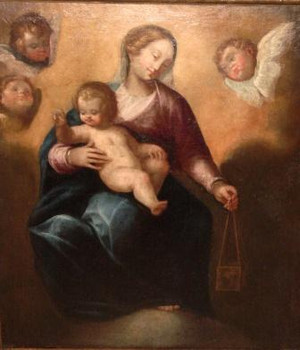
MONCALVO, PROCESSIONAL BANNER, EARLY XVII CENTURY, OIL ON CANVAS
At the beginning of the XVII century, the Confraternity of Saint Sebastian commissioned the painter Moncalvo for two processional banners, the first of which was for the solemn processional “with the figures of Our Lady of Mount Carmel, Saint Sebastian and other great saints, decorated with gold and fringes”, completed in 1606. News is found of the second work in June 1662, as “[…] also another one of the Virgin which was used at the time for burials”. Fifty years later, the regulation of 8 April 1663 prescribes “for the processions every fourth Sunday of the month, one may carry what is deemed for the feast of the dead; given the same hand of the skilled and excellent painter who made the other one”, thus indicating Caccia as the same artist of the two banners, of which the smaller one is cited in the inventory of 30 September 1683 as “the other one with the Virgin and the souls in purgatory”. The decline of the banners sparked the confraternity brothers to create a copy in the same years: as early as the beginning of the XVIII century, the traces of the documents on Moncalvo’s original banners were lost. The comparisons with other similar works – for example the painting of the same subject exhibited in the Confraternity Museum in Acceglio – make one think of a reuse of the pre-constructed models in Moncalvo’s studio, perhaps by his collaborators or by his daughter Orsola Maria, also a painter. Moncalvo is active in the city with other paintings, such as Saint Lucy in the Cuneo Cathedral, San Diego of Alcalà at the Sanctuary of the Saint Mary of the Angels and the fresco that features the Nativity of the Virgin, conserved today at the CRC Foundation.
Guglielmo Caccia called “il Moncalvo”
Born probably in 1568 in Montabone, he began his career in the modest Casalese artistic environment in the second half of the 1580s whereas his nickname derives from his habitual residence in the small town of the same name near Asti. In addition to his Piedmontese training, he apparently traveled to Bologna where he became familiar with the works of Carracci. Starting in 1605, he begins his good friendship with Charles Emanuel I, for whom he works at the Viboccone Palace and for the great gallery in the Royal Palace in Turin (both destroyed). Subsequently he will also be quite engaged in Lombardy. A good part of his late works show interventions by his daughter Orsola Maddalena, also a painter; there are many replicated prototypes and studio works, always characterized by delicate tones as well as transparent and tenuous colors. The artist’s death is registered in the parish books in Moncalvo as 13 November 1625.
The Devotions
In contemporary language, the term ‘devotion’ often has a negative or partial acceptation with respect of the Faith. In reality, it involves any interior behavior (which translates into gestures, signs and words) that expresses the love toward God (up to mystical or ecstatic consequences) and toward one’s neighbor. In his Introduction to the Devout Life at the beginning of the 1600s, Saint Francis de Sales wrote, “True and living devotion is nothing else than a true love of God. Devotion is to be practiced differently by the nobleman, the workman, the servant, the prince, the widow, the young girl, the wife. True devotion destroys nothing at all; on the contrary, it perfects and fulfills all things.”
Such extraordinary institutions bring about a great renewal in Christian life. The great preaching of the orders reformed by the Council of Trent and those which stemmed from the same (Jesuits, Theatines), united with the new artistic forms of the Baroque period, developed an incredible vivaciousness of “devotion” in less than a few decades. It was connected to the imitation of the lives of Christ, Mary and the Saints, to be united with the specific needs and social, work, health and age conditions. The Madonna becomes more and more the model for any woman of any age or social status: young girl, virgin, wife, mother, widow. Christ on the cross symbolized the source of strength for every human suffering; the life of the saints becomes identifiable for every person, category and profession. Belonging to an organized group such as a confraternity means immediately finding the incentive to develop a concrete Christianity, taking responsibility for all the most problematic aspects of life: education, helping the poor, orphans, widows, sick, imprisoned, and the dead, according to the needs of the Works of Mercy. Consequently, garments, sacred objects, insignias, scapulars and images multiply. Processions become more than ever one of the moments of total expression by the entire society of its needs, affiliations, proposals and faith.
Madonna of Loreto
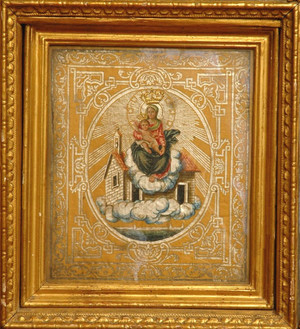
Madonna of Loreto, XVIII century Piedmontese | Oil on canvas
On the back of the painting is written: “10 February 1816. In the same house of Our Holy Father, Pious VII performed the benediction of this painting representing the Holy Virgin of Loreto. This painting was therefore carried to Loreto on March 15 and left in the same holy house in Loreto, where it hung an entire night until the 16th of the same month, being custodian of said Holy House of Giu[...] Brancha (?) 20 March [...] Cuneo fe[...]”
Our Lady of Sorrows
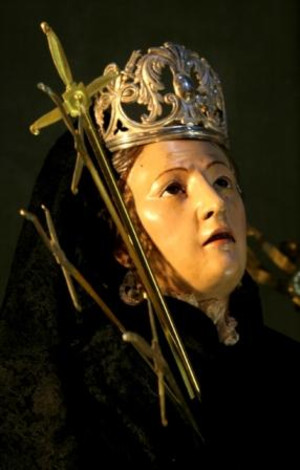
Our Lady of Sorrows, XVIII century Piedmontese painter | Carved, engraved, painted wood
This is not an entirely carved statue, but an image “to be dressed” in which only the visible parts have been refined and painted (hands and face), whereas the rest of the work is a sort of mannequin. The dress was probably an evening gown offered as a gift to the Madonna by a devotee.
Our Lady of Sorrows with the Body of the Dead Christ
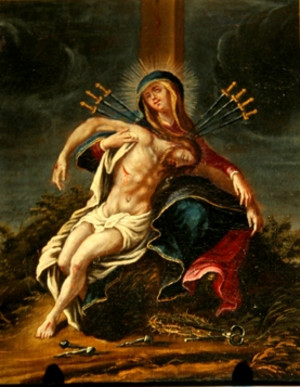
Botta Studio, Our Lady of Sorrows with the Body of the Dead Christ, First half XVIII century | Oil on canvas
The work is stylistically attributable to the Botta studio, a well-known family of Cuneese painters. The iconography of the painting is quite particular since it unites the image of the Madonna pierced by swords (Our Lady of the Seven Dolors) to the Pietà (Jesus Christ’s dead body lying in his mother’s lap).
Our Lady of Sorrows
Over the course of history, believers have invoked the Mother of Christ in many ways, just as there are thousands of nicknames for the mother in a family. Some titles are connected to apparitions (Our Lady of Lourdes), others to the special correlations with Jesus (Mother of Mercy), while others to the moments in life and the mystery of Mary (Immaculate, Assunta). If we consider the litanies, every invocation derives from a particular experience of a group of believers or of a monastic community that, in turn, communicates (preaching) for the good of all (devotion). The oldest and most fundamental title is “Mother of God”, with which the Church has invoked Mary since the IV century. “Madonna” is the medieval origin and was the sobriquet given to every woman of status. The Friar Servants of Mary, a group of brothers formed in Florence in the XIII century, were the ones who brought Our Lady of Sorrows to common worship. Traditionally, there are seven sorrows, a symbolic number that indicates entirety and connected to the sufferings of Christ the Son, from his circumcision to his death. In the Gospel of John, Mary is at the foot of the cross, suffering along with her Son until the very end. Our Lady of Sorrows is portrayed wearing black with tears in her eyes and a sword (or seven swords) which pierce her heart, as Simeon foretold in the Gospel: “…a sword shall pierce thine own soul”.
Scenes of the Passion
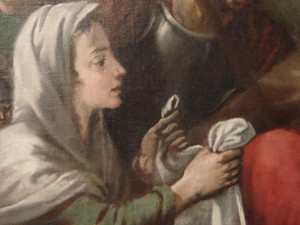
Giovanni Battista Bruno, Scenes of the Passion, First half XVII century | Oil on canvas
The theme of the Passion is of fundamental importance for the Christian faith as it represents the point of contact between the Divine and man; through the suffering and death of the son of God, man will be guaranteed divine salvation. This is the theme that Giovanni Battista Bruno depicts in the two paintings: Christ Meets Veronica and Christ Nailed to the Cross. The empathic interpretation and the psychological connection of his representations are very important to the artist, in fact in these paintings the protagonists are in the foreground with such dimensions as to create the effect of coming out of the frame, almost creating contact with the viewer. In the first painting, the empathic reference is highlighted by the triangulation of the scene in which the light placed on Veronica’s veil accentuates the sweetness, contrasting the harsh features of the armigers, which stand out through Bruno’s fast brush strokes. The painting manifests a high formal level and the terms of the compromise are read between a classical tendency and Caravaggesque naturalism. With a refined virtuosity, the artist describes the tears on Veronica’s face placing it in a dialogue with Christ’s face described with a surprising realism: the beaded drops of blood on his forehead, the red tunic to indicate the passion, his shoulders to hold up the weight of the cross, the serene countenance and sweet glance of affectionate sadness which seems to be more worried about what will happen to the others rather than to himself. In addition, the centrality of the painting is underlined by the hand gestures of the various protagonists, which create an imaginary circle with their contact, placing the face of Christ to the center. Closing the painting in an imaginary background, Bruno depicts the tense figures with his rich brush strokes in an absent dialogue. In the second painting, Christ Nailed to the Cross, the Christological figure is positioned diagonally, almost to dividing the scene of the painting into two parts; in the background, we see a group of people among which soldiers and the Virgin Mary, who give the impression of being isolated and absent, as if they were not part of the scene at that moment, whereas in the lower part of the painting the scene is animated, dramatically producing the sense of contrast between the indifference of the four executioners intent on finishing their work as soon as possible and the state of resigned spiritual suffering of Christ, more than physical suffering. The representation is made even more dramatic by the use of a chromatic range and by the pictorial method so typical of the artist, called “spotted”. The neutral background, on which is the entire scene is built, emphasizes the psychology of the characters in the foreground, accentuating their features and characteristics. In the register of 1662, it is stated that the two great paintings were hung in the presbytery, flanking Molineri’s ancon. Based also on the indications in the confraternity’s inventory, the critics had stylistically attributed the paintings to the studio of the Bruno brothers, who were active in the Cuneese area in the first half of the XVII century. The restoration work, which was completed in May 2012, led to the discovery of only Giovanni Battista’s signature (hidden in the gold-plated wooden frame), which constitutes an important point of reference for the study of the manner of the studio. According to the inventories and the historical sources, the two brothers apparently completed an entire apostolate for the Confraternity of Saint Sebastian, comprised of sixteen paintings, a “niche” painting of Our Lady of the Assumption and two small paintings depicting Saint Lawrence and Saint Stephen. It is worth remembering that in the city of Cuneo, the Bruno brothers also completed the important wall paintings with the stories of the Cross for the same confraternity, signed and dated “Iulius et io Baptista Fratres de Bruni pingebant anno MDCXXVI”.
The Bruno Brothers
Giulio Bruno, seventeenth-century Piedmontese painter, works in Genoa first at the studio of Lazzaro Tavarone, then for Giovanni Battista Paggi, where he matures artistically. The “spotted style” described in the biography by Raffaele Soprani (1674) will render him quite relished to several assayers, among which the great art collector Giovanni Carlo Doria. In 1625, he leaves Genoa for political reasons then once back in Piedmont he works with his brother Giovanni Battista for various Cuneese commissions. As of today, we are still not able to differentiate Giulio from Giovanni Battista, even though there are evident interventions by both in various works.
The Confraternities
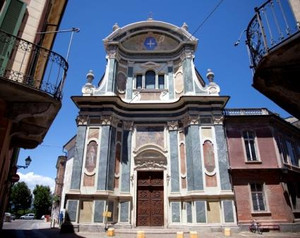
With the pressure of the orders dedicated to preaching (Franciscans, Dominicans, Carmelites) beginning in the XII century, a great religious awakening was developed and soon groups of lay people decided to live community forms of service in prayer and in charity. The confraternities were born, groups of persons who declared themselves “con-fratelli, i.e. “with brothers”. Little by little, each confraternity became structured with its own oratory with a specific form of service and garments. The confraternities are one of the oldest forms of public associations of faithful Christians, of which both lay people as well as religious may become part of, with the purpose of training and supporting spiritual life, promoting specific aspects of public worship, and apostolic or charitable service. In order to obtain ecclesiastical juridical recognition, the confraternities must be approved by a bishop to the Holy See, provide a charter and elect their own moderators according to the statues, maintain a list of the participants and prepare them with a suitable novitiate period, regularly account for the management of their activities, both the assembly of the participants and the ecclesiastical authorities. The confraternities have built their churches on these principles, founded, directed and enlivened hospices for pilgrims, hospitals, orphanages and various forms of mercy, to the point of being known in many regions as “Mercy”. Various confraternities have been present in Cuneo since the XII century, but there are three which have had an autonomous seat in its own oratory with centuries-old activities: the Confraternity of Saint James for the pilgrims, then evolving into Saint Sebastian for those inflicted by the plague; Holy Cross was dedicated to the sick, the poor and the abandoned children; Saint John Beheaded, or Saint John the Merciful, to assist those condemned to death and their families, particularly their orphans. The Church reformed confraternities and associations (other forms of laical associations) with the Council of Trent, recognizing a strong autonomy and finding a new impulse which led them to become involved in all the areas which we recognize today as public or social (hospitals, prisons, orphanages, insurance sector, financial loans). Above all in the XVII century, these groups increased in number and as far as social prestige (the greater confraternities nominated their members as councilors in municipal and judicial areas, for example). Even today the confraternities continue to operate for the good of the communities, often reconstructed with duties suitable to current affairs, as has happened in the last few years for the Confraternity of Saint James (assistance for the Way of Saint James, also known as “O Camiño de Santiago”) and for the Church of Mercy (first aid assistance).
HOLY CROSS
A “Society of the Virgin Mary”, already existed in Cuneo in 1290 at the convent of Saint Francis, dedicated to the Marian prayers, the care of the poor and the sick, and founded a hospital in 1319. In 1424, three more of these societies were incorporated by decree of the bishop, thus forming the “Hospital of the Disciples of the Holy Cross”. For six centuries, the confraternity flourished around the Church of the Holy Cross, reconstructed in the current building in 1710-12, the Mount of Mercy Hospital, receiving pilgrims and orphans. In 1960, the hospital was moved to a new location.
SAINT JAMES AND SAINT SEBASTIAN
The origin of the Confraternity of Saint James, with an oratory at the old Saint Mary Parish Church, has been lost over time; its presence ever since the beginnings of Cuneo was attested by the tomb epigraph of the priest of Saint James in 1211. It was a place of welcome for pilgrims, founded by ex-pilgrims. Around 1481, with the decline of pilgrimages, the confraternity dedicated itself to the emergencies of the plague, adding a devotion to Saint Sebastian. In 1606, the association of Our Lady of Mount Carmel was founded, which became the new spirit of the church until recent times.
SAINT JOHN BEHEADED OF THE MERCIFUL
In 1595, a confraternity of the Merciful was also formed in Cuneo to assist prisoners and those condemned to death. It was located in an oratory not far from the gallows where the sentences were performed and up until 1633 provided for the management of a house for the orphans of the condemned persons. The church, dedicated to Saint John Beheaded, was reconstructed in 1727 near a new orphanage. With the Napoleonic suppressions, the confraternity and hospice were moved to the ex-convent of the Church of Our Lady of the Annunciation, together with the Charity Hospice. Its activities were closed in 1961.