

In the SIXTEENTH CENTURY the old confraternity merges with the SAINT SEBASTIAN confraternity, protector against the plague. This is the period in which the city is fortified and when the PASSERBY is no longer recognized as the Christ to be hosted, but as a hostile FOREIGNER, the bearer of siege and disease.
The plague hit, one of the most feared epidemic diseases in the history of mankind because of its destructive force. These diseases are often indicated as divine penances, so people seek comfort in religion. The cult of miracle workers against the plague, like Saint Sebastian and Saint Roch, becomes particularly intense and votive churches appear in many places while the number of pilgrims increases. The plague provokes a profound mutation on society and the extreme losses of human lives led to its major reconstruction. Better socio-economic and hygienic conditions must arrive before the epidemics disappear almost completely, for example a great number of cases of cholera will hit at the end of the XIX century, with thousands dying of Spanish Flu at the end of the First World War. Even in Cuneo and in the surrounding territory the impact of the epidemic was devastating: the Parish Church of Saint Mary alone counted nearly 500 deaths. The prayer displayed in this room is the sixteenth-century laud recited by the brothers of the Church of the Holy Cross in Cuneo as supplication for the city.
The few reliable sources on the figure of the saint are the Depositio martyrum (354 AD) and the Explanation of Psalm 118 by Saint Ambrose (340-397 AD) on which the legend of the Passio Sancti Sebastiani by the monk Arnobius the Younger (V century) was most likely created. Perhaps born in Milan to a Milanese mother and a Narbonnese father, Sebastian moved to Rome in 270 AD to undertake a military career, becoming commander of the first Praetorian Guard under the emperors Diocletian and Maximilian. Thanks to his position, he was able to comfort and help the imprisoned Christians and care for the burial of martyrs; it was precisely for this reason that Diocletian condemned him to be tied to a pole and shot with arrows. Believed dead, he was left as food for the animals. The noblewoman Irene, who came to recover the body to give him a worthy burial, realized that he was still alive so she took him to her house and cared for him. Once healed, Sebastian continues to proclaim his faith, doing so before the emperors, who then condemn him to death by flagellation (ca. 304 AD); the body was thrown into the Cloaca Maxima so that the Christians could not recover it. Sebastian then appeared to Lucina in a dream, indicating where his body was so that it buried in the Catacombs on the Appian Way. An episode of the Gesta Langobardorum recounts that a terrible pestilence hit Rome and Pavia in 680 AD, but was ended upon the advice of an angel who asked for the construction of a chapel in honor of Saint Sebastian in the Church of Saint Peter in Chains in the two cities; the martyr is elected protector against the epidemics. The saint is venerated on January 20 and is considered the third patron saint in Italy, after the two apostles Peter and Paul. In Cuneo, the first church dedicated to the saint was erected after the initiative of the Municipality near the Gate of Nice in 1431.
Saint Sebastian
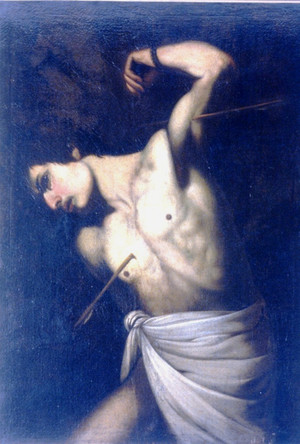
- Saint Sebastian. XVII century, LIMONE PIEMONTE.
In the High Middle Ages, Sebastian was depicted as an old man dressed as a Roman soldier. From the XV century, he was portrayed as a handsome young nude man tied to a tree, or to a column, and pierced with arrows. The first martyrdom is considered as a symbol of evil; according to the classical and Biblical tradition, the arrows represent the divine penance and the plague is the metaphor of such penance.
Saint Roch
Saint Roch was born in Montpellier in 1295. Following a religious crisis at the age of 20, he donated his possessions to the poor and the sick in order to begin his search for Christ. He began a long period of wandering throughout France, then reaching Italy in the midst of cities that were depopulated by the plagues. When he arrived in Rome, he dedicated himself to the care of those infected by the plague without fear of being infected himself; weakened by long fasting and fatigue, he became ill and sought refuge in a grotto to wait for his death. The legend recounts that he was fed by a dog, which brought a piece of bread every day, stolen from his master’s castle. Saint Roch healed and began his return journey, but was arrested with the accusation of espionage, imprisoned in Voghera where he spent five years before dying. Several of the iconographic symbols of Saint Roch are the dog, which represents the divine faith, the lesion of the plagues, which is a reminder to devote oneself completely to others, the staff that is a reminder of the wandering toward the search for the Eternal, and the bread as a memory of the Eucharist.
Episodes of the Life of Saint Sebastian
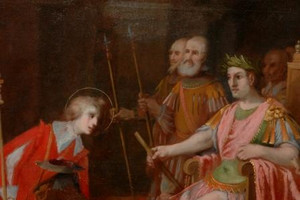
Episodes of the Life of Saint Sebastian, Ligurian-Piedmontese painter ca. 1637 | Oil on canvas
Sources attest the presence of the worship of Saint Sebastian in the city as early as 1431. In that year, the deliberation of the Municipal Board granted the construction of a chapel dedicated to the saint; according to local sources, there were already images with the stories of the saint’s life in this primitive small church. The eighteen paintings were commissioned by the most illustrious families of the city belonging to the confraternity of Saint Sebastian, whose coats of arms are shown. In a regulation in 1628, Giovanni Antonio Molineri is engaged to produce “sixteen paintings on the life of Saint Sebastian” (he had frescoed the Evangelists in the presbytery of the church in the same year). However, the artist dies in 1631 due to the ferocious plague that devastates the country therefore in 1632 the commissions go to “two foreign painters” who were in the city that year. Another regulation in January 1637 demands the completion of the paintings: the confraternity brothers request that the work be finished for the upcoming feast of Saint Sebastian (January 20). The wall paintings are traditionally attributed the Bruno brothers, even though the restoration revealed the intervention of at least two different workers not equally expert. Stylistically they constitute a link between the figurative culture of the Bruno brothers and the Cuneese painters active around the second half of the century. From an artistic point of view, it is captivating and pleasing: the figures have naturalness in their movement and manners, the colors are well graduated and have relevant effects of light. A painting refers to the one beside it like an uninterrupted conversation to be passed on with its Christian significance. The eighteen paintings hung in the church until the second half of the XVIII century and remained exhibited until the French Revolution on occasion of the procession of Our Lady of Mount Carmel. The choice of the iconographic program is intended as a form of invocation for the end of the plague that severely hit the city in the early years of the seventeenth century. The figurative cycle focuses on the episodes of the life of the saint, which refer to the Passion of the sixth century. In the wall paintings, we discover a Sebastian dressed with seventeenth-century clothing and with the heraldic coats of arms, at the commissioner’s request. We must realize that during the procession they were seen by the entire city, therefore the family arms had to appear quite clearly. The heraldic elements are currently in a study phase, but it is already possible to clearly identify the coats of arms of the Lovera, Bava, Rebaudengo and Riperti families. These wall paintings recount several of the most important phases of the life of the saint, from his birth to his important military career, to the conversion of numerous important people in the Roman Empire, up to his martyrdom. It is interesting to note that only the first martyrdom of the saint is depicted, the one which took place when “Then Diocletian ordered him to be tied to a stake in the middle of the Campus Martius, and commanded his soldiers to transfix him with arrows. And the soldiers shot so many arrows at him that he was covered with barbs like a hedgehog; and then, thinking that he was dead, they left him there.” (Jacopo da Varazze, Golden Legend). In the inventories of the Confraternity in 1672 on the ceiling of the oratory there was also “a large painting... with the arms of Captain Bottero, representing the last Martyrdom of Saint Sebastian”, the one in which the saint is stoned and his corpse is thrown into the Cloaca Maxima. The work, most likely an integral part of the series exhibited here, is no longer part of the patrimony of the confraternity.
Heraldry
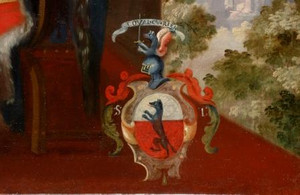
In order to talk about heraldry, it is indispensable to understand the meaning of the different terms that make up the vocabulary of this subject. The term “arms” is defined as the entirety of all the figures, emblems, colors and ornaments that serve to identify a person, a family, or an entity. In other words, “arms” is a synonym for “emblem”. However, heraldry is the discipline that teaches the arrangement of the arms therefore it explains how an emblem must be constructed. The coat of arms is the discipline that teaches the understanding of the meaning of the arms, and how to describe them correctly, in heraldic terms.
The Processions
Christian worship has always been expressed through processions, the orderly and solemn march of the people of God toward a destination. The idea is certainly shared with the Hebrew religion and with all the main religious cultures of all time. With the crisis of the great pilgrimages (Holy Land, Santiago de Compostela), the frequent wars in European countries and the pressure for renewal from religious orders, processions have become a sort of “mini-pilgrimage”, where the image of “Church = people en route” can be expressed even more significantly. All the people process behind the cross of Christ that opens every procession (“whoever does not follow me and take up the cross is not worthy”, Jesus says) and are subdivided according to their affiliated groups (confraternities, associations, religious, clergy, notables), displaying the respective garments and insignias, singing and praying as “a single heart and a single soul”. The image of the Madonna or a patron saint or the body of a defunct soul accompanied on his last journey is carried in the middle of the procession. These are also brothers who ‘walk’ among brothers, encouraging and interceding for them. Within these same liturgies, processions are developed: entrance processions, offertory processions, communion, marking the itineraries and the legs of the journey in the stone and marble of the church floors (the famous “Cosmatesque” styles of the great Roman basilicas, for example). Beginning in 1200, with the crisis of the Eucharistic practice, there are new ways of bringing Jesus in the midst of his people and for centuries the Eucharistic worship is based on the procession of Corpus Domini, of His Body carried through the streets and the houses of every local community. The processions become a great “exhibition” (not necessarily only in negative terms) of the whole society of the time, also becoming a pretext for arguments and disagreements about the rights of precedence, itineraries, journey segments, a display of garments and insignias. The contemporary liturgy rediscovers the processions as an effective sign of dynamism and communal environment of Christian conduct. People need to march even today, publicly manifesting their affiliated groups and processions so marches multiply the cortège and the various types of demonstrations that express the old and new ideologies with their laical symbols (slogans, signs, banners).
The Procession of the Confraternities
The Procession of the Confraternities, Cuneese painter, first half XVII century | Oil on canvas
This painting depicts the procession of the main Cuneese confraternities (Holy Cross, Saint Sebastian, Saint Bernard, Saint John the Baptist) and the city’s nobility to the Chapel of Saint Sebastian. The building was erected by the wishes of the municipality in 1431 “near the Gate of Nice” (in the area of modern-day piazza Galimberti) remaining active until 1691, the year of its permanent abandon due to an explosion. In the scene, the different groups appear carrying lanterns, crucifixes and banners, among which perhaps the fifteenth-century Christ of the Crusades (today at the Holy Cross Church) and Moncalvo’s bammer recorded in the inventories of the Church of Saint Sebastian of which there seems to be a trace today in the Church of Our Lady of Mount Carmel exhibited in the museum hall of the same name. The chronology of the painting leads one to believe it is not too distant from the pestilence that devastated the city in the 1630s. The painting is mystifying as there is a combination of a strictly realistic rendering (we distinctly recognize the view of the Gesso Valley side with the city tower, the Church of Saint Francis and the façade of the Church of Saint Mary of the Woods whose belfry collapsed during the siege of 1557) as well as a more imaginative version (the mountain chain in the background does not appear to be very precise compared to the actual orography), juxtaposed like backdrops of a small theater that host the parade of authorities in the foreground. The attention with which the urbanistic structure was achieved makes one think of the use of an incisory model, perhaps a devotional print or one of the view of Cuneo from the siege of 1557. The documents state that in 1599 there were already disputes regarding the subdivision of the groups in the procession as well as the precedence for carrying the “pallium”; the municipal orders state that “to remove any inconvenience and noise” it is entrusted “to the brothers disciplined in the four associations”. The initials on the bottom right-hand side (GAB) probably refer to the initials of the commissioner – not yet identified today – on the model of the wall paintings of Saint Sebastian exhibited in this same hall.