

The primitive church recognizes the MARTYRS (those who gave their lives to bear witness to the Gospel) as the people most similar to Christ, thus caring for their sepulchers and proclaiming them “SAINTS”, similar to Jesus, therefore called to RISE AGAIN.
Soon the same courageous testimony is also identified in people who live their life “extraordinarily”, even though not becoming a martyr (the Virgin Mary, for example). The first saint who was not martyred was Saint Martin, Bishop of Tour, thanks to his extraordinary charity (of which the famous episode of his cloak is an eloquent symbol) and to his untiring work with the evangelical message. The bodies of the saints are thus considered signs of Christ and prodigious signs flower on their tombs. With the expansion of the Church, the number of relics (literally “fragments”) connected to the bodies of saints multiplies in order to take the “proof” in the “flesh and blood” literally to even the smallest communities which many people had already lived as Jesus, therefore it is possible for everyone. Even the objects (connected perhaps to the martyr) or the places (since they are also called “saints”) are considered valid. The increasing request for relics brings about an infinite amount of their fragmentation (more and more minute particles of bone) or the veneration of objects which when connected with them become relics (for example, most of the relics connected to the Cross of Christ). We cannot fully comprehend today the importance which the believers gave to the relics at that time; some phenomena can also generate fanaticism and superstition at times, to the point of becoming one of the theses of Luther’s objection, and for this reason after the Council of Trent the Roman Church will care for their correct veneration even more, through reconnaissance of the bishops and supporting documentation to attest the truthfulness.
Anthropologists agree that the birth of the concept of “history” was when man began to care for burials or other forms of interment. In fact, preserving memories means remembering and handing down the fact lived by one or more persons and preserving the person’s remains has been the proof of the most immediate testimony ever since the earliest civilizations, even before documents or writings. Christians also venerated a tomb that was empty! Jesus rose from the dead and promised to raise all those from the dead who wish to live the Gospel as He had lived it. The primitive church recognizes the martyrs (those who gave their life to bear witness to the Gospel) as the persons most similar to Christ, thus caring for their burials, proclaiming them “saints”, similar to Jesus and therefore called to rise again. Soon the same courageous testimony is also identified in persons who live their lives “extraordinarily”, even though not becoming a martyr (the Virgin Mary, for example). The first saint who was not martyred was Saint Martin, Bishop of Tour, thanks to his extraordinary charity (of which the famous episode of his cloak is an eloquent symbol) and to his untiring work with the evangelical message. The bodies of the saints are thus considered signs of Christ and prodigious signs flourish on their tombs. With the expansion of the Church, the number of relics (literally “fragments”) connected to the bodies of saints multiplies in order to take the “proof” literally in the “flesh and blood” to even the smallest communities, which many people had already lived as Jesus, therefore it is possible for everyone. Even the objects (connected perhaps to the martyr) or the places (since they are also called “saints”) are considered valid. The increasing request for relics brings about an infinite amount of their fragmentation (more and more minute particles of bone) or the veneration of objects which when connected with them become relics, for example, most of the relics connected to the Cross of Christ. We cannot fully comprehend today the importance that the believers gave to the relics at that time: Saint Helena “dismantles” half of Jerusalem to bring the Christ’s trial platform to Rome, the flagellation column, the fragments connected to the manger and the passion. The Venetians and the Barisans smuggled the bodies of Saint Mark and Saint Nicholas from eastern churches to make them the center of their civilization, while Friar Elias hid the body of Saint Francis so well in Assisi for fear of it being stolen that it was rediscovered casually only after six centuries. To bury their dead, the Pisans bring tons of earth next to the famous leaning tower dug from near the Church of Saint Sepulchre in Jerusalem, no longer calling itself a cemetery, which literally means ‘place of rest’, but rather “holy field”. The Basilica of Loreto and the Sainte-Chapelle Holy Chapel in Paris are gigantic treasure chests to house respectively the stones of the Holy House and the Christ’s Crown of Thorns. At the same time, an entire building is constructed in Rome to house the “Holy Stairs”. Such phenomena sometimes generate fanaticism or superstition (several famous pages of the Decameron deride this type of religiousness), to the point of becoming one of the cornerstones of Luther’s thesis. For this reason, after the Council of Trent the Roman Church will care for their correct veneration even more, through reconnaissance of the bishops and supporting documentation to attest the truthfulness.
Relics Casket of Saint Fabian
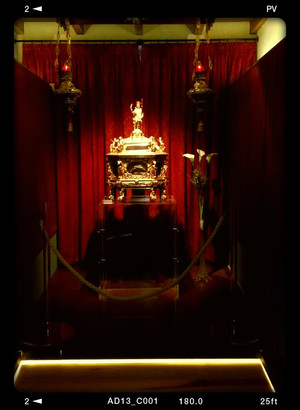
Relics Casket of Saint Fabian, Piedmontese artist, XVII century, glass and carved, engraved and gold-plated wood
Among the numerous relics to which the documents from the Confraternity bear witness, those of Saint Fabian, which the Confraternity had obtained from Rome in absence of those of Saint Sebastian, appear in an ordainment from January 1656, which states “a small casket in which to place the Relics of the glorious martyr Saint Fabian made […] whose manufacture, workmanship and everything P. Paolo Scotto (councilor) paid more than two hundred ducats and gives this small casket as a copious donation and transfer to said Company”. Several months later, we find a testimony of the unsealing of the casket, in which the Body of Saint Fabian in found”. We later learn that the painter Lelio Scaffa is paid for “the painting of an iron grating for the small casket of Saint Fabian”. This is therefore the precious gift of a confraternity brother, whose important invoice testifies the devotion with which the holy relics of the martyr were considered.