

PILGRIMAGE is a true EXERCISE, a privileged practice of the Christian life ever since the ancient times. In the pilgrim world of the Middle Ages, pilgrimages and ITINERARIES constitute a true font of spiritual and cultural RICHES.
Ever since the ancient times, the Church has felt the need to “be on a journey” toward the Holy Land, which had witnessed the events of the life of Christ, and toward places that are full of testimonies of faith, such as the tombs and the RELICS of apostles and martyrs. With the establishment of the religions in Europe, the great pilgrimage routes are developed: toward Santiago de Compostela, Rome, and the Church of the Holy Sepulchre. Little by little, they become pilgrimage destinations, even the local sanctuaries, places of miracles or testimonies around the worship of the Holy Virgin Mary or the saints. Starting in 1300, the Jubilee years mark a new need for mass pilgrimages, beyond the regional or national borders; this need finds new growth beginning in the second half of the XIX century (Lourdes, Assisi, Loreto, etc.). With the Second Vatican Council, the Church strongly rediscovered its vocation as a people “en route”, whose wording is also identified with many virtual itineraries (spiritual, catechetic, etc.). As a consequence, routes and itineraries are marked which still exist and are being used today.
Saint James «the Greater» (distinguishing him from the apostle James of Alphaeus) was the son, along with John, of the fisherman Zebedee. He was among the first called by Jesus and a witness of many of the most significant events of the life of Christ, such as the Transfiguration and the night at Gethsemane. After the death and resurrection of Christ, James assumes a prominent role in the Christian community in Jerusalem. A tradition dating back to Isidore of Seville narrates that James went to Spain to spread the Gospel. James was the first apostle martyred, in the spring of the year 42. After his decapitation, according to the Golden Legend, his disciples smuggled his body and miraculously took it the coast of Galilee. On his tomb, discovered in a placed called “Campus Stellae” (Compostela), miraculous events occurred in quick succession, such as the apparition led by the Christian troops of the Reconquista (840), in which so much Muslim blood was apparently shed as to merit the epithet of “Matamoros”. Christian Europe had already given birth to the pilgrimages toward Compostela in the X century, which in 1075 brought on the construction of the grandiose basilica dedicated to him. The pilgrimage to Santiago became one of the main pilgrimages of medieval Christianity, along with Jerusalem and Rome. In Cuneo, a church dedicated to Saint James dates back to the XIII century, a place where municipal acts are executed (1240, 1248) and serving as an annex of the Church of Saint Dalmatius of Pedona (1246); its name is given to one of the districts of the city (on the Gesso side, toward the suburbs). Along the “ruata bovisii” (“Boves route”, today the district of Mondovì), a hospice existed to receive the pilgrims. In the XV century, the oratory was renovated with the title of Saint James and Saint Sebastian.
Saint James the Greater
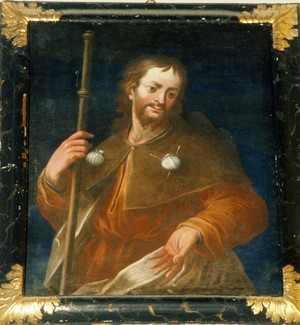
- Bottega dei Botta, San Giacomo maggiore. Inizio XVIII secolo. CASTELMAGNO.
Even though he had never been a pilgrim, Saint James is normally depicted in pilgrim’s clothing, with a staff and a pumpkin as a canteen, a hat and a shell, the symbol of those who went to Santiago. In some cases, a book was added to these attributes, as was for the other apostles, a sign of his direct testimony of the word of God. The feast day of Saint James is celebrated on July 25.
The Apostolates
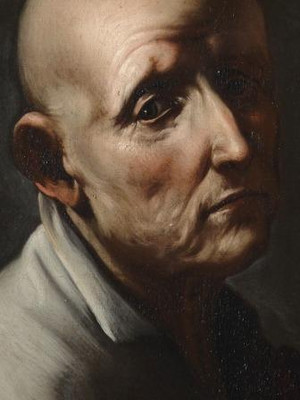
Apostles, Piedmontese painter, First half XVII century, Oil on canvas
The paintings exhibited here were part of an apostolate. Beginning in the second half of the XVII century, many churches began using these sorts of cycles of this genre. In Cuneo, the two greater confraternities distinguished themselves once again: Holy Cross, with a series of fifteen canvases acquired in 1645, and Saint Sebastian, which boasted even two series of paintings of this type. In 1650, the confraternity obtains «a total number of fifteen Apostles [sic] with its frame gilded by Mr. Clemente Perlasco of Mondovì» and a few years later an additional series was acquired. In fact, the 1673 inventory of Saint Sebastian documents «two apostolates, the one from Rome with walnut frames with 14 profiles and the other one by Bruno with 16 new gold frames». The stylistic analysis and the results of the restoration intimate that over the course of time the paintings had a tormented story: they were repainted and framed and many were lost, although Monsignor Riberi counted twelve still in the choir and three in the sacristy in 1933. Of the thirty original paintings, only the five exhibited here have been conserved: Saint Bartholomew, Saint James the Greater, Saint Judas Thaddaeus, Saint Thomas and Saint Andrew. The other three were discovered fortuitously during the restoration work on the complex. The collection is most likely the fruit of the consolidation of the paintings recovered by both apostolates, since they seem to relate to different styles. Saint Bartholomew, Saint Thomas and Saint Judas Thaddaeus are attributable to a Piedmontese painter active around the second half of the seventeenth century, aware of the outcome of the Roman paintings from the beginning of the century. However, Saint James the Greater and Saint Andrew are a reference to a more local style, also attributable to higher models (even a Caravaggesque type) as seen in the use of perspective and the style for details.
The Apostolates
Following the Council of Trent (1545-1563), a great number of churches acquired apostolates, the images of Christ and the twelve apostles, sometimes accompanied by the images of Mary, Saint Paul and other Evangelists. The Council had firmly reiterated the “apostolic succession”, in contrast with the Protestant reformation, the direct investiture continuity (technically “ordination”, through the invocation of the Spirit and the unction) between apostle and bishops. Therefore exhibiting the figures of the apostles in church meant reiterating the role of the bishops as outright successors to those whom Christ himself had called. Per directive of the Council, the bishops committed to residing permanently in the communities entrusted to them, instructing the priests and visiting them regularly through “pastoral visits”.
Processional Banner
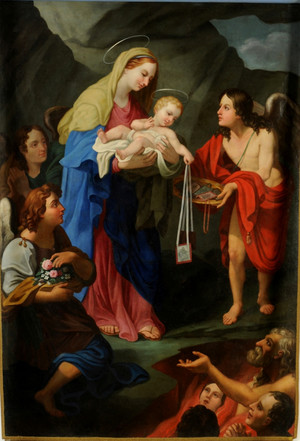
Processional Banner, Cuneese painter, XVIII century, Oil on canvas
The confraternity inventories document the presence of numerous processional banners over the course of the centuries, reaching up to six at a time. Banners depicting Our Lady of Mount Carmel together with Saint Sebastian and the souls in purgatory were mentioned as early as the XVII century. The rather frequent use of these apparatuses (used for the processions which were held every fourth Sunday of the month) naturally caused attrition. Thus in November of 1726 the painter Pietro Paolo Indio is called for restoration work; what is displayed here may be the result of one of those refurbishments. The artist, perhaps a member of the confraternity, was also called in the following years (1743) to “patch and wash the ancon of the great altar” made by Molineri. The banner exhibited represents the compendium of all the devotions that came in succession within the Confraternity housed at the Diocesan Museum today. On one side, Saint James and Saint Sebastian at the foot of Christ on the cross; on the other side, Our Lady of Mount Carmel with the souls in purgatory. It was utilized for the solemn procession of Our Lady of Mount Carmel (July 16) until the year 2011, then subject to arduous restoration which has rendered it legible again.
The Pilgrimages
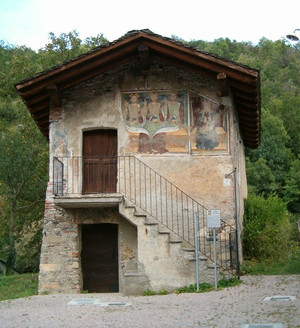
- VALGRANA, Holy Trinity Hospice
A journey is certainly a powerful metaphor for life in numerous cultures and traditions: from Ulysses’ legendary journey to the Gran Tour of the past few centuries, entire generations have identified a rediscovery of themselves through journeys, the meaning of life, the search for knowledge and truth. For a believer (not only Christian), the metaphor is best represented by a pilgrimage, in which a generalized and faceless search is not proposed, but rather one with a precise and significant destination from the beginning, where a sanctuary, sacred place and a place of miracles become images of the last and final encounter with the Transcendent, in the afterlife. Starting from the Old Testament, the Christian faith has seen the pilgrim’s journey as a search for God: from the pilgrimage of Abraham to the pilgrimage of Moses and his people toward the Promised Land. Ever since the ancient times, even more with the conclusive affirmation of Christianity in the West, the Church has felt the need to “be on a journey” toward the Holy Land, which had witnessed the events of the life of Christ and toward the places that are full of testimonies of faith, especially the tombs of the apostles and martyrs. With the establishment of the religions in Europe, the great pilgrimage routes are developed toward Santiago di Compostela, Rome, and the Church of the Holy Sepulchre. Starting in 1300, the Jubilee years mark a new need for mass pilgrimages, beyond the regional or national borders. This need finds new growth beginning in the second half of the XIX century (Lourdes, Assisi, Loreto, etc.). With the Second Vatican Council, the Church strongly rediscovered its vocation as a people “en route”, whose wording is also identified with many virtual itineraries (spiritual, catechetic, etc.).
Ex Votos
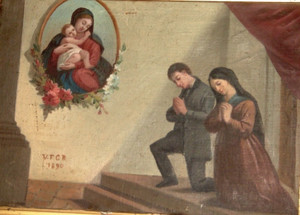
Ex-votos are objects offered as a gift to a divinity following the fulfillment a vow, mostly for a healing or a request granted. This practice is common in many religions, but in the Christian world, it flourishes particularly in relation to the sanctuaries. In most cases, the walls of these places are covered from floor to ceiling with metal objects depicting the healed body parts, silver hearts or small-sized paintings made of poor materials, which recount the daily stories and gratitude for a received grace. In the Cuneese area, many recall everyday country life, raising animals and crops, not to mention the references to the great world wars.