

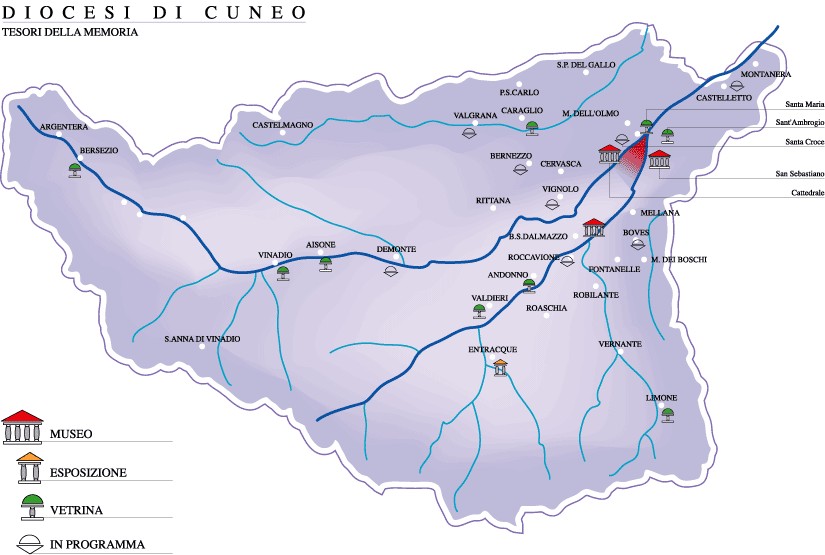
Just as the Diocese of 1817 represented a point of arrival for a thousand-year-old itinerary of faith and devotion in which Cuneo and its valleys were the protagonists, the museum network constitutes the common thread of the cultural and artistic vocation of its own territory.
A border territory which has known how to host and sustain extremely important centers for faith over the centuries, monastic complexes crop up along the pilgrimage routes and the commercial routes, able to nourish and broaden the local devotion in extremely difficult places, threatened by wars, famines and pestilences. Great moments of devotion were able to merge in the sanctuaries, points of welcome and hope for the pilgrims; rural chapels and votive pillars were erected with great sacrifice, often outright treasures of art, knowing how to catalyze the faith of even the simplest communities. The processions and the birth of the confraternities, out-and-out testimonies of the Christian message and fundamental cornerstones of society over the centuries, still retain their unaltered vocation even today. The desire to keep alive the awareness of the testimonies which are scattered around the city and the valleys is a fundamental objective within the scope of the preservation of art and the message connected to it; united through a common enhancement project, they now find their fulfillment in the diocesan museum institution.
The continued desire of the Cuneese inhabitants to have their own bishop led the Parish Church of Saint Mary to request the construction of a bishopric in the first half of the XV century, even though opposed by the Diocese of Mondovì, under whose jurisdiction both the city of Cuneo as well as the Vermenagna and Gesso Valleys fell at that time. About two centuries later, the city municipal board attempted again to obtain the bishop’s throne, through a formal motion addressed to the Pope and the Duke of Savoy. Once again, the difficulties proposed from Rome and the outright rebuff from Turin caused the negotiations to fail, which went aground permanently in 1667. Despite a series of additional attempts, it was not until 17 July 1817 that the Diocese of Cuneo was finally erected, through the bull Beati Petri Apostolorum Principis issued by Pope Pius VII to redefine the new districts of the alpine dioceses. The new diocese included the territory of the Cuneese valleys, wide and varied yet culturally defined; until that time the territory had been subdivided between the Dioceses of Turin, Mondovì and Fossano. Delineating the religious and cultural panorama of the new diocese meant tracing an itinerary that arose from the oldest ecclesiastical presences in the territory. Firstly, the Abbey of Saint Dalmatius of Pedona, strategically placed at the mouth of the Alpine valleys and a symbol of the great medieval monasteries, connected in an eternal game of alliances and conflicts with the local communities. Starting from the XII century, the monastic presences became the cornerstone of the sacredness in the valleys, becoming the most important urban presence within the same city of Cuneo since the Napoleonic period. In addition to the great monastic complexes and sanctuaries, such as Saint Anne of Vinadio and Castelmagno as well as the numerous parish churches, outright symbols of devotion, the phenomenon of the confraternities became more and more established a large part in the construction of religious and civil identity of the individual communities. They are living manifestations of the laical worship of which the same Diocesan Museum inherits the tradition of one of the most important in the city of Cuneo: Saint Sebastian. From the XVI-XVII centuries, and for most of the XVIII century, the counter-Reformation fervor supplied the spark for an out-and-out rebuilding of the ecclesiastical buildings (churches, chapels, sanctuaries) which brought about the exquisite Baroque works we can still admire today, and for which artists and workers intertwined their activities in the city and in the valleys. The desire to highlight artistic treasures often concealed even in the smallest area in the Cuneese valleys has created a network in the last few years through which we become acquainted with not only the ecclesiastical buildings, often rich with frescoes, sculptures and paintings, but also the treasures conserved in the sacristies, an indispensable crowning element to the visit of a sacred building. The itinerary twists through the most important centers of the Grana, Gesso, Stura and Vermenagna Valleys, flowing into the city and toward the flatland of Castelletto Stura and Montanera. In such a way, a constant dialogue is instilled between the museum and the numerous diocesan worlds, making it possible to follow the development of artists and workers who for centuries had cut through the territory of the Diocese, constituting an artist, cultural and devotional thread that culminates today in the new museum.
Private Collections
Every objet d’art connected to sacredness assumes a role that is not simply aesthetical, but rather has a very precise “use”: an object created for an altar, a prayer, a sacrament, a procession. When deprived of its intended context, the significance of the sacred object suffers greatly. A poorly interpreted renewal and pauperism of the Church, the reformed liturgy of the Second Vatican Council, the decrease and crisis of religious and hundred-year-old institutions, the exuberance of objects, the decrease of “specialized” personnel (sacristans, etc.), the economic boom, and thousands of other causes have jeopardized an uncontrollable dispersion of a noteworthy heritage accumulated over the centuries. The antiques market responded to this tendency not always according to a simple logic of profit, but by bringing together (a collection) those things that others had dispersed. A renewed sensitivity of Christian communities, the drafting of computer inventories, and the safeguarding of assets demanded by the governing authorities have finally contributed to putting a stop to such regrettable situations. The collector has somehow helped to return the sacred objects to their original context. In this sense, the Fulcheri family and the Peano family, along with other private donations, have actively collaborated by giving part of their collections to the museums.
The Way of the Cross
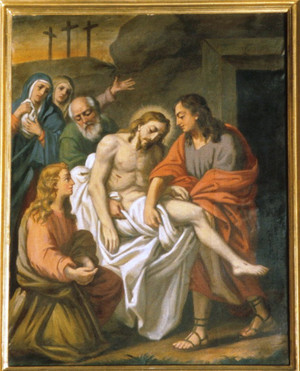
- Angelo Giacobi detto il Pastore. Via Crucis | Gesù Cristo trasportato al sepolcro, 1875-1876, olio su tela. CUNEO, Chiesa di San Sebastiano
[The Way of the Cross – also called the Via Dolorosa – is a form of a spiritual walk that originates from the scenes taken in the Gospels and in the tradition of the recounts of the Passion. It is connected to clearly defined “physical” places (Christ’s walk to Jerusalem toward Calvary); stylized by episodes (the stations) organized in a canonic form and put in every parish at the mercy of the faithful. Ever since the early centuries, the diaries of the pilgrims in the Holy Land have reported the use of praying in the main places, which were the backdrop to the life of Jesus. The advent of the Crusades and the great preaching of the new Orders (Franciscans, Dominicans, and Carmelites) also brought to Europe the desire to retrace the same walks and somehow contemplate those images visually. Sacred representations were then created, musical works performed live or depicted through paintings and sculpted scenes: the lamentations, the Sacri Monti (Sacred Mountains). Prayer itineraries were also created, such as the Mysteries of the Rosary as well as the Way of the Cross, for which the Franciscan Saint Leonard of Porto Maurizio the greatest propagator. In 1741, Pope Benedict XIV defined the canonic form of a true journey as subdivided into 14 stations, with the same indulgences of the pilgrims in the Holy Land.